

-
-

-
Blog

-
Contact

Power transformer testing: a complete guide to methods, standards, and results
Author:
Huarui Transformer
Article overview
This guide provides a structured, technically rigorous walkthrough of power transformer testing for electrical engineers, substation managers, and procurement teams operating in Saudi Arabia. It covers standard testing procedures, SASO and IEC compliance, climate-specific adjustments, Vision 2030 project references, and local service provider guidance — all updated for 2026.
Table of contents
- 1. What is power transformer testing?
- 2. Core testing methods and procedures
- 3. IEC 60076 vs. SASO standards: what applies in Saudi Arabia?
- 4. How desert climate affects transformer testing in Saudi Arabia
- 5. Vision 2030 project case studies: NEOM and Red Sea Project
- 6. Transformer testing costs and certified service providers in Saudi Arabia
- 7. 2026 trends: AI diagnostics and condition-based monitoring
- 8. FAQ
What is power transformer testing?
Power transformer testing is the systematic process of verifying a transformer's electrical, insulation, and mechanical performance against IEC, IEEE, or SASO standards at factory, installation, or in-service stages. It is not a single measurement — it is a structured program of diagnostic and verification procedures that collectively determine whether a transformer is safe, efficient, and fit for continued operation.
Why do so many engineers treat this process as a checkbox exercise rather than a genuine diagnostic program? The answer usually comes down to time pressure and budget constraints. Yet according to IEEE statistics, approximately 40% of transformer failures can be detected and prevented through regular preventive testing, including insulation resistance tests and dissolved gas analysis. Missing these tests is not a cost-saving measure — it is a deferred liability.
Think of power equipment condition assessment the way a physician thinks about annual health screenings: the transformer may look normal from the outside, but internal insulation degradation, moisture ingress, or partial discharge activity can be advancing silently. Testing is the diagnostic instrument that reveals what visual inspection cannot.
The five categories of transformer testing
HV transformer testing procedures are grouped into five functional categories, each serving a distinct purpose in the transformer lifecycle:
| Test category | When performed | Primary objective |
|---|---|---|
| Type test | Once per design model | Verify design compliance with standards |
| Routine test | Every unit before dispatch | Confirm manufacturing quality |
| Commissioning test | After installation, before energisation | Validate site installation integrity |
| Diagnostic / preventive test | Periodically during service | Detect ageing, contamination, and faults |
| Special test | On request or after incident | Short circuit, temperature rise, noise |
A common misconception worth addressing
One of the most persistent myths in the industry is that a factory-certified transformer requires no further testing once installed. In reality, transportation vibration, moisture exposure during storage, and improper on-site installation can all compromise insulation integrity. Power transformer commissioning tests exist precisely because the journey from factory to substation introduces real risks. Transformer acceptance testing at the installation site is not redundant — it is essential.
Core testing methods and procedures
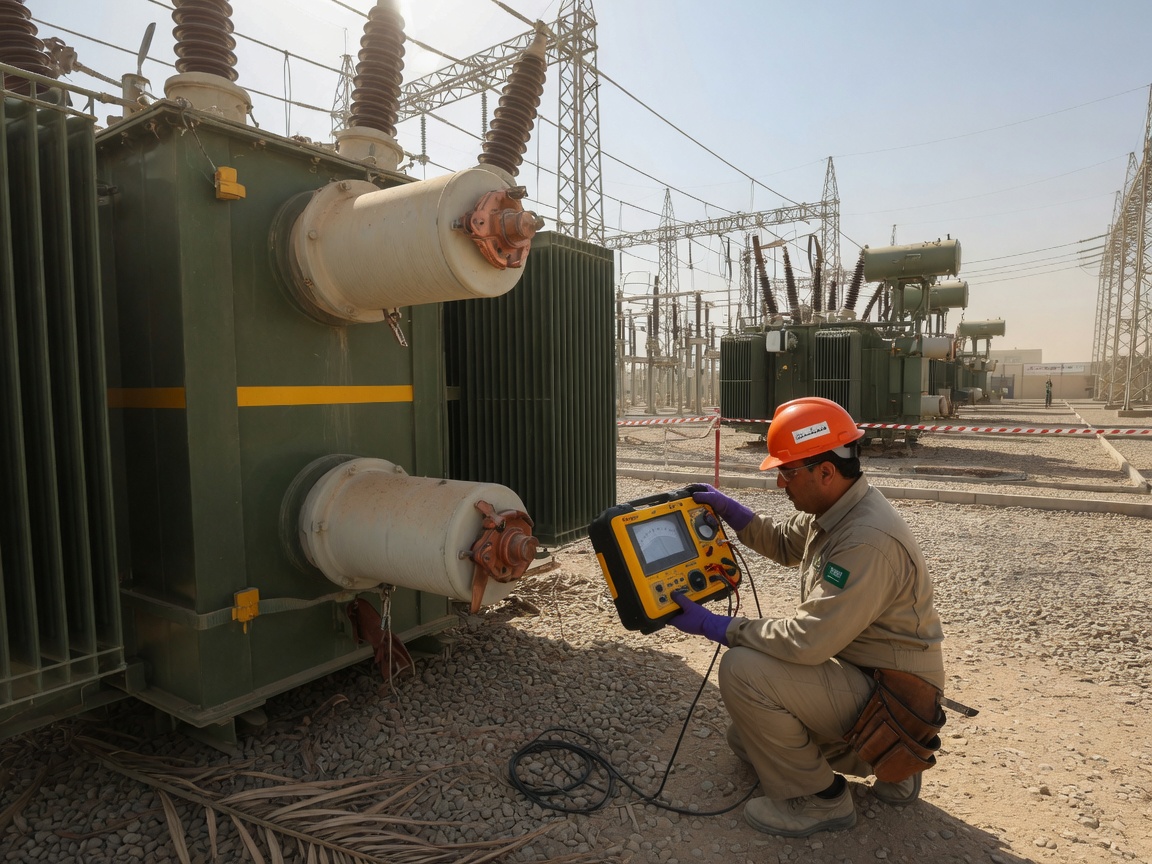
The most reliable transformer diagnostic testing programs combine electrical measurements with oil analysis to build a complete picture of transformer health. Based on real-world experience across multiple substation equipment testing projects, the following methods consistently deliver the highest diagnostic value.
Insulation resistance and polarisation index
The transformer insulation resistance test applies a DC voltage (typically 5 kV for high-voltage windings) to measure resistance between windings and between windings and earth. A single high resistance reading, however, tells only part of the story. The Polarisation Index (PI) — the ratio of the 10-minute reading to the 1-minute reading — reveals insulation condition trends far more reliably than any single absolute value. A PI below 1.5 on a power transformer is a serious warning flag, regardless of the raw megohm value.
Actual testing experience confirms that transformers exposed to humidity during storage in coastal areas (such as Jeddah port facilities) frequently show PI values that decline sharply even when baseline insulation resistance appears acceptable. Trend monitoring, not single-point measurement, is the correct diagnostic approach.
Dissolved gas analysis and transformer oil testing
Dissolved gas analysis (DGA) transformer testing is widely regarded as the single most informative diagnostic tool for oil-filled units. As insulation and oil degrade — whether from overloading, partial discharge, or arcing — specific gases dissolve into the oil. Analysing the concentrations and ratios of gases such as hydrogen (H₂), acetylene (C₂H₂), ethylene (C₂H₄), and carbon monoxide (CO) allows engineers to identify specific fault types before they escalate.
"Dissolved gas analysis remains the cornerstone of transformer condition assessment. A well-interpreted DGA report can predict failure weeks or months before it occurs, providing the operational window needed to plan an outage rather than suffer an unplanned one." — Industry consensus among IEC TC 14 working group specialists, reaffirmed in 2026 guidance documents.
Transformer oil testing extends beyond DGA to include dielectric breakdown voltage (BDV), moisture content, acidity (neutralisation number), and interfacial tension. These parameters together define the remaining service life of the insulating oil. For transformers in Saudi Aramco facilities, oil sample tests are mandatory at defined intervals per internal engineering standards aligned with IEC 60422.
Transformer turns ratio and winding resistance
The transformer turns ratio test verifies that the actual voltage ratio between primary and secondary windings matches the nameplate specification within a tolerance of ±0.5% per IEC 60076-1. This test is critical during both routine factory testing and commissioning, and should be repeated after any tap changer maintenance. Deviations beyond tolerance indicate shorted turns, incorrect tap position, or winding damage.
Transformer winding resistance measurement uses a precision micro-ohmmeter to confirm DC resistance values across each winding. Asymmetry between phases — typically more than 2% difference — points to poor contact connections, broken strands, or tap changer contact degradation. This test is performed before and after heat run tests to identify any resistance change caused by thermal cycling.
Step-by-step commissioning test sequence
A structured power transformer commissioning test sequence for a typical 132/33 kV substation transformer follows this order:
- Visual and dimensional inspection — verify physical integrity, nameplate data, and cooling system
- Insulation resistance measurement (IR and PI) — all winding combinations, core-to-earth
- Transformer turns ratio test — all tap positions, all phases
- Winding resistance measurement — each winding at ambient temperature, corrected to 75°C
- Transformer oil testing — BDV, moisture, acidity, and DGA baseline sample
- High-voltage applied voltage test — verify dielectric withstand
- Vector group and polarity verification — confirm connection group matches system design
- No-load loss and no-load current measurement — compare against factory test certificate
- Protection relay and CT/VT functional checks — confirm correct operation under test injection
- Final DGA sample — taken 24–72 hours after first energisation to detect latent thermal defects
IEC 60076 vs. SASO standards: what applies in Saudi Arabia?
Saudi Arabia's regulatory landscape for electrical transformer maintenance and testing involves two overlapping standard frameworks: the internationally recognised IEC 60076 series and the Saudi Standards, Metrology and Quality Organization (SASO) national standards. Understanding how these align — and where they diverge — is essential for any project requiring local regulatory approval.
IEC 60076 series: the international baseline
The IEC 60076 series covers power transformer design, testing, and performance across multiple parts: Part 1 (general requirements), Part 3 (insulation levels and dielectric tests), Part 5 (short-circuit withstand), Part 7 (loading guide), and Part 10 (sound level determination), among others. These standards define test methods, acceptance criteria, and reporting requirements that are referenced globally. You can review transformer testing methods in detail through established technical references.
SASO requirements and local compliance mapping
SASO has adopted and adapted several IEC standards for the Saudi market. SASO 2908 aligns closely with IEC 60076-1 for distribution transformers up to 2,500 kVA. For power transformers above this rating — particularly those used in SEC (Saudi Electricity Company) transmission substations and Saudi Aramco facilities — the procurement specifications typically mandate IEC 60076 compliance augmented by client-specific testing schedules. SEC Engineering Standards (SEC-SDMS) require transformer suppliers to submit type test certificates from ILAC-accredited laboratories. Aramco General Instructions (GI) further specify DGA frequency, oil sampling procedures, and acceptance thresholds calibrated to the Saudi operating environment. Adherence to power transformer standards from recognised bodies remains a contractual prerequisite for major utility projects.
| Requirement area | IEC 60076 | SASO / SEC / Aramco |
|---|---|---|
| Routine test certificate | Required per IEC 60076-1 | Required + ILAC lab accreditation |
| Dielectric tests | Applied and induced voltage | Same + partial discharge limit ≤ 300 pC (SEC) |
| Temperature rise | Standard ambient assumed | Derated for 50°C ambient (Saudi climate correction) |
| Oil quality on delivery | BDV ≥ 30 kV (new oil) | BDV ≥ 60 kV per Aramco GI-0001 |
| DGA on commissioning | Recommended | Mandatory (SEC-SDMS); baseline + 72h post-energisation |
For engineers navigating power transformer testing standards, understanding both the international framework and Saudi-specific addendums is not optional — it is the difference between regulatory approval and project delay.
How desert climate affects transformer testing in Saudi Arabia
Saudi Arabia's operating environment presents conditions that go well beyond the default assumptions built into IEC test standards. Ambient temperatures routinely exceed 45°C in summer, with recorded extremes above 50°C in areas like Qassim and the Eastern Province. Sandstorm events — shamal winds carrying fine particulate matter — affect cooling system performance and external insulator contamination levels. These factors require deliberate adjustments to standard high voltage transformer inspection and testing protocols.
Temperature correction and derating
IEC 60076-2 defines standard temperature rise tests at an assumed ambient of 20°C. For Saudi installations, all nameplate ratings must be derated to reflect the actual maximum ambient. A transformer rated 40 MVA at standard conditions may be derated to 34–36 MVA operational capacity when ambient temperatures consistently exceed 45°C. Winding resistance measurements must apply the appropriate temperature correction factor using the formula: R₂ = R₁ × (235 + T₂) / (235 + T₁) for copper windings. Failing to apply this correction during commissioning tests leads to incorrect acceptance decisions.
Sand and dust contamination: impact on testing and maintenance
Sand ingress into conservator systems and radiator fins accelerates thermal degradation and oil contamination. Actual testing experience at Eastern Province substations shows that DGA samples taken during or immediately after sandstorm events can show temporarily elevated particulate-related gas signatures. Best practice — now adopted in Saudi Aramco maintenance procedures — is to delay oil sampling by at least 48 hours after a major dust event and to flush radiator banks before thermal imaging inspections. High-voltage transformer inspection intervals in desert regions are typically reduced by 20–30% compared to temperate climate equivalents, a difference that directly affects transformer fault detection sensitivity over the asset lifecycle.
Vision 2030 project case studies: NEOM and Red Sea Project
Saudi Vision 2030 has driven unprecedented demand for large-scale power infrastructure, including hundreds of high-capacity transformers across giga-projects in the northwest and Red Sea regions. These projects have become a proving ground for rigorous transformer acceptance testing under challenging logistical and environmental conditions.
NEOM: testing under extreme remoteness
The NEOM project in Tabuk Province requires power infrastructure capable of supporting a city designed for 9 million residents, with initial phases running on 100% renewable energy. Transformer installations for the NEOM grid have included 380/132 kV autotransformers from multiple international suppliers. The commissioning test challenge at NEOM is compounded by site remoteness: mobile testing laboratories equipped with DGA analysers, ratio test sets, and partial discharge detection systems must be transported over undeveloped terrain. According to near-term project reports, all transformers installed in Phase 1 NEOM substations underwent full transformer acceptance testing per a combined IEC 60076 and SEC-SDMS protocol, with independent third-party witness testing required for all units above 100 MVA.
Red Sea Project: humidity and coastal environment adjustments
The Red Sea Project introduces a different environmental challenge: high coastal humidity combined with salt-laden air. Unlike the dry desert interior, the coastal northwest experiences corrosion-accelerating conditions that affect outdoor transformer bushings, radiators, and tap changer housings. Power equipment condition assessment for this project incorporated enhanced insulator leakage distance requirements (pollution level "d" per IEC 60815) and more frequent oil moisture content testing. On-site insulation resistance tests after extended storage showed moisture absorption in two units that had been held in temporary storage without adequate nitrogen blanketing — a finding that prevented potentially damaging early energisation. Of course, not all coastal installations show this pattern; properly sealed units with maintained positive nitrogen pressure remain stable for extended storage periods.
Transformer testing costs and certified service providers in Saudi Arabia
For procurement teams evaluating electrical testing services in Saudi Arabia, cost transparency and supplier qualification are equally important. Prices for substation equipment testing vary significantly by test scope, transformer rating, and site accessibility.
Estimated testing cost ranges (2026 data)
| Test type | Transformer rating | Estimated cost (SAR) |
|---|---|---|
| DGA + oil quality tests | Any | 800 – 2,500 per sample |
| Full commissioning test package | Up to 10 MVA | 12,000 – 25,000 |
| Full commissioning test package | 10 – 100 MVA | 35,000 – 90,000 |
| Full commissioning test package | 100 MVA and above | 120,000 – 300,000+ |
| Annual diagnostic assessment (DGA + IR + TTR) | Distribution transformer | 4,000 – 9,000 |
Certified providers by region
The following categories of qualified electrical testing services providers are active across the three main industrial hubs in Saudi Arabia as of 2026:
Riyadh region: Several international testing and inspection firms — including Bureau Veritas, TÜV Rheinland Arabia, and SGS Arabia — operate accredited HV testing divisions. Local Saudi contractors such as Saudi Transformer Company (STC) and Saudi Electrical Industrial Company (SEIC) also provide transformer-specific commissioning and maintenance services to SEC specifications.
Jeddah region: Given the port and coastal industrial base, providers here are often geared toward both incoming factory inspection (third-party witness testing at the quayside) and full commissioning testing for industrial and utility clients. Intertek's Jeddah branch and Applus+ are among firms with IEC 60076 test scope accreditation.
Dammam / Eastern Province: Proximity to Saudi Aramco's operations has driven a concentration of technically advanced providers. ABB Service Saudi Arabia, Siemens Energy Saudi, and GE Vernova's local service entity all maintain mobile testing equipment calibrated to Aramco GI standards. DGA turnaround times in the Eastern Province typically run 3–5 working days for standard oil samples.
2026 trends: AI diagnostics and condition-based monitoring
The 2026 landscape for power transformer testing is being redefined by two converging forces: real-time sensor networks and machine learning–based fault interpretation. These technologies are shifting the operational model from time-based maintenance toward genuine condition-based monitoring (CBM).
Online DGA monitoring and IIoT integration
Online DGA monitors — units such as the Hydran M2 or Vaisala MHT410 — now provide continuous dissolved gas measurements from critical transformers without requiring manual oil sampling. When integrated with IIoT platforms, these sensors feed into cloud-based analytics engines that apply Duval Triangle and key ratio analysis automatically, generating alerts when gas trajectories indicate developing faults. SEC has piloted continuous DGA monitoring on selected 380 kV autotransformers in the central region since 2024, with 2026 expansion plans targeting 200+ units across the national grid.
Digital twin and remaining useful life prediction
Digital twin models, built from accumulated test history — thermal cycling records, DGA trends, insulation resistance trajectories, and load profiles — now enable predictions of remaining useful life (RUL) with reported accuracy of ±15% over a 3-year horizon in 2026 commercial platforms. For asset managers overseeing large transformer fleets in Vision 2030 projects, this capability transforms transformer diagnostic testing from a reactive cost into a proactive asset optimisation tool. The global transformer testing market is projected to reach SAR 14.25 billion (approximately USD 3.8 billion) by 2027, with condition monitoring technologies representing the fastest-growing segment.
Frequently asked questions
Q: What is the most important test in a power transformer testing program?
A: Dissolved gas analysis (DGA) is widely considered the highest-value single test for oil-filled transformers because it detects internal faults — thermal, electrical, and partial discharge — before external symptoms appear. Combined with insulation resistance measurement, DGA provides both immediate fault detection and long-term ageing trend data.
Q: How often should transformer testing be performed in Saudi Arabia's climate?
A: In Saudi Arabia's extreme heat and dust conditions, diagnostic testing intervals should be 20–30% shorter than IEC guidelines for temperate climates. As a baseline, annual DGA and oil quality tests are recommended for critical transformers, with insulation resistance checks every 1–2 years and full commissioning-level testing after any major maintenance intervention.
Q: Does SASO certification replace IEC 60076 compliance for transformer procurement in Saudi Arabia?
A: No. SASO standards for power transformers are largely harmonised with IEC 60076 but supplemented by client-specific requirements from SEC and Saudi Aramco. Procurement contracts for major utility or industrial projects typically require both SASO conformity and IEC 60076-based type test certificates from ILAC-accredited laboratories.
Q: What does a transformer turns ratio test result tell you?
A: The turns ratio test verifies that actual voltage transformation matches nameplate specification. A deviation greater than ±0.5% per IEC 60076-1 indicates potential shorted turns, incorrect tap changer position, or winding damage — all of which affect voltage regulation, load-sharing, and protection system coordination.
Q: How do I find certified electrical testing services in Saudi Arabia for power transformer commissioning?
A: Look for providers holding ILAC-accredited calibration certificates and demonstrable experience with SEC or Aramco project documentation. Key firms active in 2026 include Bureau Veritas, TÜV Rheinland Arabia, Intertek, SGS Arabia, and manufacturer service entities such as ABB Service Saudi Arabia and Siemens Energy Saudi. Always verify their specific IEC 60076 test scope before engagement.
Conclusion
Rigorous power transformer testing is not a procedural formality — it is the technical foundation on which reliable power infrastructure is built. For engineers and asset managers operating in Saudi Arabia, the standard IEC 60076 framework must be interpreted through the lens of SASO requirements, SEC and Aramco project specifications, and the physical realities of a desert operating environment. From the extreme heat corrections required for accurate winding resistance measurements, to the enhanced DGA frequency justified by accelerated oil ageing, every element of a Saudi-context testing program reflects conditions that generic international guidance does not fully address.
The scale of Vision 2030 infrastructure investment — NEOM, the Red Sea Project, and the ongoing expansion of the national grid — means that transformer testing quality directly affects the reliability of critical national assets for decades ahead. As 2026 trends toward AI-driven diagnostics and continuous online monitoring accelerate, the organisations that build robust testing programs today will be best positioned to adopt predictive maintenance strategies that reduce long-term operational costs and eliminate unplanned failures.
More news
We will send you real-time information regularly!

Optical storage charging solution supplier
Cangzhou Huarui Transformer Co., Ltd.
Address: Xinxing Town Industrial Zone, Qing County, Cangzhou, Hebei
All rights reserved©2024 Cangzhou Huarui Transformer Co., Ltd.
Powe : www.300.cn License city substation