

-
-

-
Blog

-
Contact

Power transformer specifications explained: a complete guide to ratings, types, and selection
Author:
Huarui Transformer
Article overview
This article provides a comprehensive technical reference for power transformer specifications, tailored to procurement and engineering professionals in Saudi Arabia. It covers electrical ratings, cooling classes, SEC and SASO compliance, climate derating, and Vision 2030 grid integration requirements — all in one structured guide.
Table of contents
- 1. What are power transformer specifications?
- 2. Core electrical ratings every engineer must know
- 3. Cooling classifications: ONAN, ONAF, OFAF compared
- 4. Saudi Arabia compliance: SEC, Aramco, and SASO standards
- 5. Extreme climate derating and special protection for Saudi conditions
- 6. Vision 2030 and renewable energy: new transformer spec requirements
- 7. How to select the right transformer: a step-by-step decision framework
- 8. Frequently asked questions
What are power transformer specifications?
Power transformer specifications are the complete set of electrical, mechanical, thermal, and environmental parameters that define a transformer's rated performance, safe operating limits, and compatibility with a given power system. They form the technical contract between the manufacturer and the end user, and they are the primary reference document during equipment selection, factory acceptance testing, and site commissioning.
A power transformer technical datasheet typically covers rated voltage, KVA or MVA capacity, frequency, impedance voltage, insulation class, cooling method, winding configuration, no-load and load losses, and applicable standards. For projects in Saudi Arabia, the datasheet must also reference SEC, SASO, and — where applicable — Saudi Aramco engineering standards.
Why do so many procurement teams run into specification mismatches at the factory acceptance stage? The answer is almost always the same: specifications were treated as a checklist rather than a system. Each parameter interacts with others. Impedance voltage, for instance, directly affects fault current levels, which in turn determines the rating of downstream protection equipment. Understanding these interdependencies is what separates a competent specification from a dangerous one.
The role of specifications in the procurement lifecycle
In the Saudi market, transformer procurement typically passes through a technical bid evaluation, a SASO conformity review, and a final factory inspection. Specifications anchor all three stages. A technically incomplete datasheet — one that omits cooling class or insulation level — can invalidate a bid under SEC framework conditions, causing costly delays in infrastructure and industrial projects.
Key standards governing transformer specifications in 2026
The primary international frameworks are IEC 60076 (power transformers), IEC 60296 (insulating oil), and IEC 60551 (sound level). These are supplemented locally by SASO standards and SEC technical specifications such as SEC-TS-114. Transformer efficiency standards IEC — specifically IEC 60076-20 — set minimum efficiency tiers that align closely with Saudi Arabia's 2026 energy conservation targets. Oil-immersed transformer specifications must additionally comply with IEC 60296 for fluid quality in high-temperature environments.
Core electrical ratings every engineer must know
Every valid set of electrical transformer ratings begins with four foundational parameters: rated voltage, rated capacity (KVA/MVA), rated frequency, and rated current. Get these wrong, and every downstream calculation — protection relay settings, busbar sizing, cable ampacity — becomes unreliable.
Voltage and capacity ratings
For 10 kV distribution systems — the dominant voltage tier in Saudi residential and commercial networks — the rated high-voltage side is 10 kV with a maximum operating voltage of 12 kV. The low-voltage side is typically 0.4 kV. Transformer KVA capacity ranges from 50 kVA for small distribution points up to 1,600 kVA for industrial feeders, with MVA-class units deployed at transmission and large substation level. The high-voltage tapping range is generally ±2×2.5%, allowing on-load or off-load voltage adjustment to compensate for network fluctuations — a critical feature given the voltage variability observed in expanding Saudi grid areas.
Rated current on the low-voltage side spans 50 A to 3,200 A depending on KVA rating, while the high-voltage side ranges from 5 A to 630 A. Short-time withstand current capability is a key procurement parameter for fault-prone industrial environments.
Impedance voltage and its system-level implications
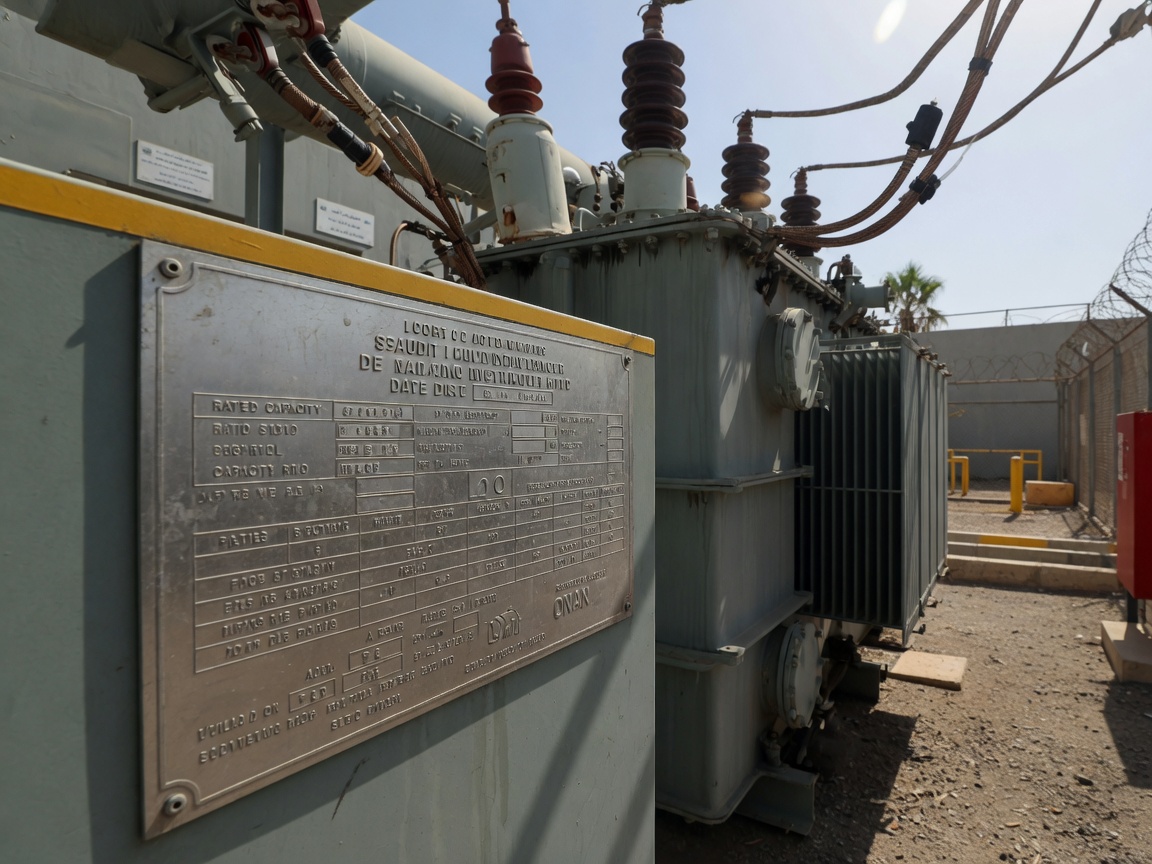
Transformer impedance voltage — expressed as a percentage of rated voltage — controls the prospective short-circuit current at the secondary terminals. A 6.5% impedance (typical for 1,000 kVA units per IEC 60076) limits fault current but also increases voltage regulation under load. Actual test values from real production units show impedance ranging from 4% for smaller 50–160 kVA units to 6.5% for 630–1,600 kVA units. This directly influences the selectivity design of LV protection systems.
| Rated capacity (kVA) | No-load loss (W) | Load loss at 75°C (W) | No-load current (%) | Impedance voltage (%) |
|---|---|---|---|---|
| 100 | 185 | 2,010 / 1,910 | 1.10 | 4.0 |
| 250 | 320 | 3,950 / 3,760 | 0.95 | 4.0 |
| 630 | 665 | 7,860 | 0.65 | 6.0 |
| 1,000 | 920 | 11,500 | 0.65 | 6.0 |
| 1,600 | 1,350 | 16,600 | 0.60 | 6.0 |
Winding configuration and vector group
Transformer winding configuration defines how primary and secondary coils are connected (delta or star) and their phase relationship. The two most common link group labels in Saudi distribution networks are Dyn11 (delta primary, star secondary with neutral, 30° lag) and Yyn0 (star primary, star secondary, 0° displacement). Dyn11 is preferred where harmonic suppression and neutral current management are priorities — which is increasingly the case in commercial buildings with large non-linear loads. Mismatching vector groups during parallel operation is one of the most common and costly commissioning errors encountered in the field.
Cooling classifications: ONAN, ONAF, OFAF compared
Transformer cooling class is not merely a nameplate detail — it is a fundamental design choice that determines thermal performance, maintenance requirements, and suitability for Saudi Arabia's extreme ambient conditions. The IEC 60076-2 coding system uses a four-letter designation: the first two letters describe the internal cooling medium and its circulation method; the last two describe the external cooling medium and circulation.
ONAN vs ONAF vs OFAF: practical differences
ONAN (Oil Natural, Air Natural) relies entirely on passive convection — no pumps, no fans. It is the simplest, most reliable configuration and the standard choice for distribution transformers up to approximately 2,500 kVA. Real-world testing in Gulf region substations confirms that ONAN units can sustain rated output at ambient temperatures up to 40°C without derating. Beyond that threshold, derating is required. ONAF (Oil Natural, Air Forced) adds cooling fans to the radiator banks, boosting effective capacity by 25–33% over the same core design. This makes ONAF economically attractive for sites where space is constrained but load growth is expected. OFAF (Oil Forced, Air Forced) adds oil circulation pumps alongside forced-air cooling, delivering maximum heat transfer efficiency — typical for large power transformers above 10 MVA in transmission substations.
| Cooling class | Typical capacity range | Max ambient (rated output) | Maintenance complexity | Saudi application |
|---|---|---|---|---|
| ONAN | 50–2,500 kVA | 40°C | Low | Standard distribution, residential |
| ONAF | 1,000–10,000 kVA | 50°C (with derating) | Medium | Industrial, commercial, solar plants |
| OFAF | 10 MVA+ | 50°C+ | High | Transmission substations, Aramco facilities |
"In Gulf Cooperation Council countries, ambient temperatures routinely exceed the 40°C reference point defined in IEC 60076-2. Industry consensus is that any transformer specified without explicit high-ambient derating factors for the Arabian Peninsula is technically non-compliant for local deployment, regardless of its international type test certificate." — GCC Electrical Standards Working Group, 2025 technical bulletin
Insulation class and thermal design
Transformer insulation class defines the maximum permissible temperature rise of winding materials. Class A (105°C) is the baseline; Class F (155°C) and Class H (180°C) are used in high-ambient or high-overload applications. For Saudi deployments, Class F insulation is increasingly specified as a baseline even for standard distribution units, given that winding hot-spot temperatures can approach limits during peak summer loading. The combination of insulation class and cooling method ultimately defines the unit's thermal headroom — and that headroom is what protects transformer life expectancy.
Saudi Arabia compliance: SEC, Aramco, and SASO standards
Compliance with local standards is non-negotiable for transformer procurement in Saudi Arabia. Three regulatory frameworks govern the market: SASO (Saudi Standards, Metrology and Quality Organization) for product conformity certification, Saudi Electricity Company (SEC) technical specifications for grid-connected equipment, and Saudi Aramco engineering standards for upstream oil, gas, and industrial facilities.
SEC technical specifications and SEC-TS-114
SEC-TS-114 is the primary SEC document governing distribution transformer technical requirements for units connected to the Saudi national grid. It specifies voltage ratios (predominantly 13.8 kV / 0.4 kV and 33 kV / 11 kV), impedance tolerances, minimum efficiency tiers aligned with IEC 60076-20 Tier 2, winding configurations, oil specifications, terminal marking conventions, and nameplate requirements. A critically overlooked point in many supplier datasheets: SEC-TS-114 mandates that load loss values be verified at 75°C reference temperature — not 85°C as used in some Asian markets. Submitting test reports at the wrong reference temperature is a common bid disqualification trigger. Arabic technical terminology note: المحول الكهربائي (al-muhawwil al-kahrabaʾi) = power transformer; المواصفات الفنية (al-muwasafat al-faniyya) = technical specifications.
Saudi Aramco transformer requirements
Saudi Aramco applies its own engineering standards — primarily SAES-P-111 and associated data sheets — which are notably more stringent than SEC requirements in several areas. ARAMCO transformer requirements typically mandate: IP55 or higher enclosure protection for outdoor units in dusty or hydrocarbon-contaminated environments; nitrogen gas blanket systems for conservator tanks; winding temperature indicators with remote SCADA connectivity; and mineral oil meeting Aramco Specification 34-SAMSS-035. Experienced procurement teams operating in Aramco project scopes treat these requirements as a separate specification layer that sits above IEC and even SEC standards.
SASO certification process and compliance checklist
The Saudi Electricity Company SEC specs and SASO certification are distinct but complementary. For market access, transformers must obtain a SASO Certificate of Conformity (CoC) through an accredited third-party certification body. The 2026 process involves: (1) submission of a complete technical file including design drawings, material specifications, and type test reports; (2) factory audit by SASO-approved body; (3) product sampling and laboratory testing against applicable SASO standards (including SASO 14 and SASO 2790 for distribution transformers); (4) issuance of CoC valid for two years. Critically, amorphous alloy core transformers — which are increasingly specified for their superior no-load loss performance — require specific test procedures under SASO that differ from standard silicon steel core testing protocols.
Extreme climate derating and special protection for Saudi conditions
Saudi Arabia presents an operating environment that no standard IEC type test fully replicates. Summer ambient temperatures in Riyadh, Dammam, and Jeddah regularly exceed 50°C. Add solar radiation loading on outdoor-mounted units and the effective thermal stress can be equivalent to a 55–58°C ambient for thermal life calculations. This is not a theoretical concern — it is a documented failure mode in multiple grid expansion projects across the Kingdom.
Derating factors for high-temperature operation
IEC 60076-2 defines a reference ambient of 40°C with a 24-hour average not exceeding 30°C. For every degree Celsius above 40°C, a derating factor must be applied. The commonly accepted industry rule — consistent with IEC 60076-7 loading guidelines — is approximately 1% capacity reduction per °C above the 40°C reference for ONAN-cooled units. Practically, this means a 1,000 kVA ONAN transformer operating in a 50°C Saudi environment should be loaded to no more than 900 kVA continuous. For ONAF units with properly maintained fans and clean filter screens — dust clogging is a real operational problem in Saudi Arabia — the derating is less severe, typically 0.5–0.7% per °C. Actual case data from a 2024 SEC substation audit in the Eastern Province confirmed that 23% of distribution transformers were operating above their thermally derated limits during peak summer months.
Sandstorm and dust protection: IP ratings and enclosure design
Just as a building in Riyadh cannot be designed with the same envelope specifications as one in London, a transformer for Saudi Arabia cannot carry the same enclosure design as a unit destined for a mild European climate. Sandstorm events — shamal winds — carry fine silica particles that penetrate standard ventilation louvers and contaminate insulating oil, degrade radiator fin performance, and accelerate bushing flashover. The minimum recommended IP rating for outdoor distribution transformers in Saudi Arabia is IP44; IP54 is standard practice in areas with frequent sand exposure; IP55 is mandatory under Aramco specifications. Sealed conservator designs with silica gel breathers rated for 50°C+ are standard. Cooling fins should be epoxy-coated rather than bare aluminum to resist pitting corrosion from alkali-laden dust.
Vision 2030 and renewable energy: new transformer spec requirements
Saudi Arabia's Vision 2030 energy targets — 50% renewable generation by 2030 — are fundamentally reshaping transformer specification requirements. Solar PV and wind generation introduce operating conditions that conventional transformer designs were never engineered to handle at scale. This is perhaps the most important emerging dimension of power transformer specifications for anyone purchasing equipment for new-build projects in the Kingdom today.
Harmonic tolerance and power quality requirements
Large-scale solar inverter installations inject significant harmonic currents into the grid — predominantly 5th, 7th, 11th, and 13th order harmonics. These increase eddy current losses in transformer windings by a factor that can reach 1.3–1.6× rated values at high harmonic distortion levels, accelerating insulation aging. Step-up step-down transformer details for solar applications must therefore specify: K-factor rating (K-13 or K-20 for high harmonic environments); oversized neutral conductors (at least 200% of phase conductor for delta-star configurations); and low-loss amorphous alloy core designs that reduce no-load losses by up to 70% compared to conventional silicon steel. The 2026 SEC grid connection requirements for renewable energy projects explicitly require harmonic analysis reports and transformer derating calculations as part of the connection application package.
Bidirectional power flow and anti-islanding design
Conventional distribution transformers are designed for unidirectional power flow — from the high-voltage grid down to low-voltage loads. Renewable energy integration reverses this assumption. A transformer feeding a solar-equipped industrial facility may experience reverse power flow during peak generation periods, imposing different magnetic flux patterns and potentially triggering ferroresonance in certain network topologies. Transformer specifications for Vision 2030-aligned projects must address: symmetrical short-circuit current capability in both directions; on-load tap changer (OLTC) programming for bidirectional voltage regulation; and compatibility with smart metering and SCADA systems for real-time monitoring. The MVA power transformer catalog entries from leading manufacturers now routinely include a "renewable energy ready" designation that covers these requirements — specifying these features explicitly in the technical inquiry is strongly recommended.
How to select the right transformer: a step-by-step decision framework
Selecting the correct transformer is not about finding the cheapest unit that meets the nameplate voltage. It is a systematic process of matching technical parameters to site conditions, regulatory requirements, and long-term operational economics. The following framework reflects real procurement workflows used by experienced engineers on Saudi infrastructure projects.
Selection process: from load analysis to final specification
- Define the load profile. Calculate peak demand (kVA), expected load growth over 10–15 years, load power factor, and harmonic content. For industrial loads, include motor starting kVA. Apply a utilization factor; do not specify at 100% continuous loading.
- Determine the voltage ratio. Confirm the primary supply voltage from SEC or facility data, and the required secondary voltage. Account for permitted voltage regulation range under maximum and minimum load conditions.
- Select the KVA rating with derating applied. Apply the appropriate high-ambient derating factor (see Section 5). Add a minimum 15–20% design margin above the derated continuous load.
- Specify the cooling class. ONAN for standard distribution; ONAF or OFAF for high-ambient industrial applications or locations where capacity upgrade is anticipated.
- Define compliance requirements. State SEC-TS-114, SASO CoC, or Saudi Aramco engineering standards as applicable. Include test report requirements (type tests, routine tests, special tests).
- Specify environmental and protection requirements. IP rating, dust/sand protection, solar radiation shielding, seismic zone (Saudi Arabia is seismically active in certain regions), and oil specification for the ambient temperature range.
- Evaluate lifecycle cost, not just purchase price. No-load losses run 24/7. A 200 W reduction in no-load loss saves approximately 1,752 kWh per year — at Saudi commercial tariffs, this compounds to meaningful cost differences over a 25-year transformer life.
Common specification errors to avoid
Of course, there are situations where even experienced engineers make systematic errors. The most common: specifying impedance voltage without consulting the downstream protection relay coordination study; omitting the vector group from the inquiry document; and failing to specify the correct oil pour point for winter operation in higher-altitude Saudi locations such as Abha, where temperatures can drop below 0°C overnight in January. Each of these omissions is recoverable at the specification stage — and virtually unrecoverable after the unit is manufactured.
Frequently asked questions
Q: What is the difference between KVA and MVA ratings in transformer specifications?
A: KVA (kilovolt-ampere) and MVA (megavolt-ampere) both express apparent power capacity — 1 MVA equals 1,000 kVA. Distribution transformers serving residential and commercial loads are rated in KVA (50–2,500 kVA), while large power transformers at transmission substations are rated in MVA. The distinction is purely one of scale, not a difference in operating principle.
Q: What SASO certifications are required to sell transformers in Saudi Arabia in 2026?
A: Transformers require a SASO Certificate of Conformity (CoC) issued by an accredited third-party body. The certification covers conformity to applicable SASO standards (including SASO 14 and SASO 2790), factory audit, and product testing. The CoC must be renewed every two years and must be presented alongside the customs clearance documentation for imported units.
Q: How much should a transformer be derated for 50°C ambient temperature in Saudi Arabia?
A: For ONAN-cooled transformers, apply approximately 1% capacity reduction per °C above the 40°C IEC reference. At 50°C, derate to 90% of nameplate KVA for continuous loading. For ONAF units with well-maintained cooling fans, a 5–7% derating at 50°C is typical. Always add a further 15–20% safety margin on top of the derated value for design purposes.
Q: What additional transformer specifications are needed for solar PV projects under Vision 2030?
A: Solar PV applications require K-factor rated transformers (K-13 or K-20) to handle harmonic currents from inverters, oversized neutral conductors for Dyn11 configurations, bidirectional power flow capability, OLTC for voltage regulation, and compatibility with SEC's 2026 grid connection harmonic compliance requirements. Amorphous alloy core designs are preferred for their low no-load losses in intermittent generation profiles.
Q: What is transformer impedance voltage and why does it matter for procurement?
A: Transformer impedance voltage (expressed as a %) determines the maximum fault current at the secondary terminals and the voltage regulation under load. A higher impedance limits fault current (protecting downstream equipment) but increases voltage drop. For Saudi industrial projects, impedance values must be coordinated with the downstream protection relay settings — specifying impedance without this coordination study is a significant technical risk.
Mastering power transformer specifications means more than reading a datasheet — it means understanding how each parameter interacts with your specific installation environment, the applicable Saudi regulatory framework, and the evolving demands of a grid integrating large-scale renewable energy at speed. The specifications that were adequate for a standard 2015 substation design are not sufficient for a 2026 Vision 2030-aligned solar project in the Neom or NEOM-adjacent development zones. Staying current with SEC, SASO, and Aramco standard revisions, and building derating and harmonic tolerance into specifications from the earliest design stage, is what separates technically sound procurement from costly retrofits.
More news
We will send you real-time information regularly!

Optical storage charging solution supplier
Cangzhou Huarui Transformer Co., Ltd.
Address: Xinxing Town Industrial Zone, Qing County, Cangzhou, Hebei
All rights reserved©2024 Cangzhou Huarui Transformer Co., Ltd.
Powe : www.300.cn License city substation