

-
-

-
Blog

-
Contact

Dry vs Oil Type Transformer: Key Differences, Pros & Selection Guide
Author:
Huarui Transformer
📋 Article Overview
This guide provides a comprehensive technical and commercial comparison of dry-type and oil-filled power transformers. It covers insulation systems, cooling classifications, US regulatory requirements, noise benchmarks, environmental compliance, and a 20-year total cost of ownership analysis — all structured to help electrical engineers and facility managers make confident procurement decisions in 2026.
📑 Table of Contents
- 1. What Is the Difference Between Dry and Oil Type Transformer?
- 2. How Each Transformer Type Works: Insulation & Cooling Explained
- 3. Head-to-Head Comparison: Performance, Cost & Efficiency
- 4. US Regulatory Compliance: NEC, NFPA 70, and IEEE C57 Standards
- 5. Real-World Noise Levels: Hospitals, Schools, and Office Buildings
- 6. Environmental & Safety Risk Analysis
- 7. Total Cost of Ownership: 10–20 Year Analysis
- 8. How to Choose the Right Transformer: Decision Framework
- 9. Frequently Asked Questions
1. What Is the Difference Between Dry and Oil Type Transformer?
The difference between dry and oil type transformer is this: a dry-type transformer uses air or solid resin as its insulating and cooling medium, while an oil-type transformer uses dielectric mineral oil — fundamentally changing where each unit can be safely installed and how it must be maintained.
That single distinction — liquid versus non-liquid insulation — cascades into differences in fire risk, acoustic performance, capital cost, long-term maintenance burden, and regulatory compliance. According to 2026 data, oil-immersed transformers still account for roughly 65% of global power transmission installations due to their cost advantage at high voltages, while dry-type units are capturing an expanding share of commercial and industrial indoor applications, now representing approximately 30% of the worldwide transformer market (source: Grand View Research).
The difference between dry and oil type transformer is not merely academic. For U.S. engineers specifying equipment under NEC Article 450 or IEEE C57 standards, the choice directly determines permissible installation locations, required clearances, containment infrastructure, and total facility operating cost over a 20-year horizon. This guide examines every dimension of that choice with the rigor the decision demands.
Why do so many facility managers still get this selection wrong? Often because they focus narrowly on purchase price while underestimating lifetime maintenance costs, regulatory exposure, and acoustic impact on building occupants. The sections that follow address all of these systematically.
2. How Each Transformer Type Works: Insulation & Cooling Explained
Understanding the internal architecture of each type is essential before comparing performance metrics. Both transformer families rely on electromagnetic induction, but their thermal management and dielectric systems diverge significantly.
2.1 Dry-Type Transformer: AN Cooling System
A dry-type transformer dissipates heat through natural air convection (AN cooling system) or, in larger units, through forced-air cooling (AF). The windings are either impregnated via Vacuum Pressure Impregnation (VPI) with varnish or fully encapsulated in cast resin — hence the common designation cast resin transformer. The cast resin transformer benefits are well documented: the sealed resin protects windings from moisture, dust, and corrosive atmospheres, making these units particularly suited to coastal facilities, food processing plants, and any environment with airborne contaminants.
A ventilated dry-type transformer, by contrast, leaves the windings partially exposed to circulating air. Lower purchase cost is the trade-off; contamination sensitivity is the limitation. In practice, the IEEE recommends VPI or cast resin construction for any installation rated above 600V in a non-climate-controlled space.
2.2 Oil-Immersed Transformer: ONAN Cooling Classification
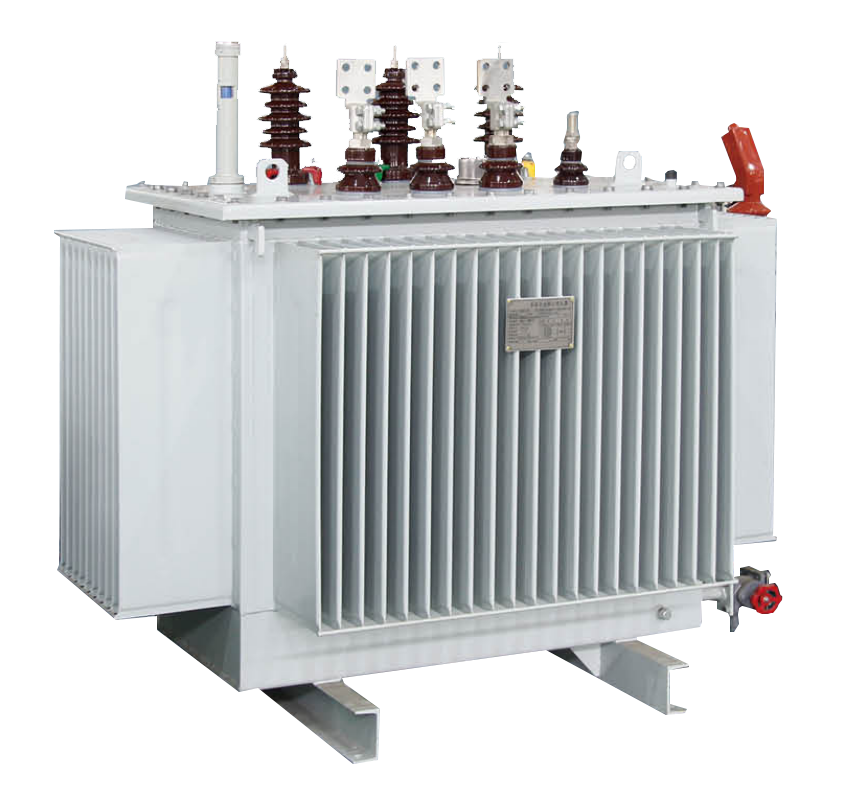
An oil-immersed transformer submerges its core and windings in transformer dielectric fluid — typically refined mineral oil, though natural ester (bio-based) oils are rapidly gaining adoption in 2026. The ONAN cooling classification (Oil Natural, Air Natural) describes the most basic configuration: oil circulates by thermal convection through radiator fins, transferring heat to ambient air. Larger units escalate to ONAF (forced air over radiators) or OFAF (forced oil and air) for higher thermal capacity.
The oil serves a dual purpose — it is simultaneously the insulating medium and the primary coolant. This dual function allows oil-immersed transformer advantages to scale: a single oil-filled unit can handle ratings from 25 kVA distribution transformers all the way to 1,000 MVA transmission autotransformers. Achieving equivalent capacity in a dry-type design requires substantially more material and cost.
"Oil-immersed transformers continue to dominate high-voltage transmission infrastructure globally due to their superior thermal performance and scalability, while dry-type technology is the preferred choice for urban indoor distribution where fire safety and environmental risk are paramount concerns." — IEEE technical standards for transformer classification and insulation

3. Head-to-Head Comparison: Performance, Cost & Efficiency
Numbers clarify what descriptions obscure. The table below compiles 2026 data points drawn from manufacturer specifications, IEEE C57 benchmarks, and field performance studies to give procurement teams a direct comparison across the parameters that matter most.
| Parameter | Dry-Type Transformer | Oil-Immersed Transformer |
|---|---|---|
| Typical Capacity Range | 15 kVA – 30 MVA | 10 kVA – 1,000+ MVA |
| Insulation / Cooling Medium | Air / Epoxy resin (AN/AF) | Mineral or ester oil (ONAN/ONAF) |
| No-Load Loss (typical, 1 MVA) | ~2,000 W | ~1,400 W |
| Load Loss (typical, 1 MVA) | ~10,500 W | ~8,500 W |
| Efficiency at Full Load | 98.5% – 99.0% | 99.0% – 99.5% |
| Unit Purchase Cost (1 MVA, USD) | $45,000 – $80,000 | $25,000 – $50,000 |
| Average Noise Level (indoor) | 45 – 60 dBA | 50 – 70 dBA |
| Fire Risk Classification | Self-extinguishing (F1 rated) | Flammable (mineral) / Low-fire (ester) |
| Installation Environment | Indoor, basement, high-rise | Outdoor, substations, industrial yards |
| Maintenance Interval | 3–5 years (inspect/clean) | 1–2 years (oil sampling/test) |
| Expected Service Life | 25–30 years | 30–40 years |
| Overload Capacity | Limited (~10% short-term) | Higher (~20–30% short-term) |
The transformer efficiency comparison reveals that oil-filled units hold a measurable advantage at full load — a gap that translates directly to energy cost differences over a 20-year operating period. Academic research on dry-type vs oil-immersed transformer performance consistently confirms this efficiency delta, though the margin narrows for amorphous-core dry-type designs increasingly specified under Energy efficiency standards for dry and oil type transformers.
3.1 Transformer Cooling Methods Comparison: What the Ratings Actually Mean
The ONAN cooling classification and AN cooling system transformer designations follow IEC 60076 and IEEE C57.12 nomenclature. For US procurement, it's important to recognize that NEMA transformer ratings map to these IEC designations — a common source of specification confusion. The first letter pair describes the internal cooling medium and circulation; the second pair describes the external cooling medium. AN = air natural (dry); ONAN = oil natural, air natural. Misreading these codes in a bid specification can result in receiving a unit with inadequate thermal capacity for the actual load profile.
3.2 Power Transformer Insulation Types and Longevity
Power transformer insulation types directly govern aging rate. Cellulose paper insulation saturated with mineral oil ages according to the Arrhenius equation — every 10°C rise in hot-spot temperature roughly halves insulation life. Cast resin systems, by contrast, use Class F or Class H insulation rated to 155°C and 180°C respectively, tolerating higher ambient temperatures without equivalent degradation. Of course, there are situations where resin insulation can develop micro-cracking under repeated thermal cycling, particularly in high-altitude installations where temperature swings are severe — a limitation worth acknowledging during the design phase.
4. US Regulatory Compliance: NEC, NFPA 70, and IEEE C57 Standards
US regulatory compliance is arguably the most consequential factor separating the two transformer types for commercial and industrial projects — yet it is consistently underweighted in generic comparison articles. The NEMA guidelines on dry-type and liquid-filled transformer specifications provide the foundational framework, but project-level compliance requires navigating three distinct regulatory layers.
4.1 NEC Article 450 and NFPA 70 Installation Requirements
NEC Article 450 governs transformer installation for both types. Key distinctions for US projects:
- Dry-type transformers rated 112.5 kVA or less may be installed indoors without a fire-resistant vault, provided they are located at least 12 inches from combustible materials (NEC 450.21(A)).
- Dry-type transformers rated above 112.5 kVA installed indoors must be in a transformer vault constructed per NEC 450.42 or must be listed as "suitable for use in a building" — typically requiring a Class 155°C or higher insulation rating.
- Oil-immersed transformers installed indoors require a dedicated transformer vault with 3-hour fire-rated construction, oil-containment sump, and automatic fire suppression under NEC 450.26. This adds $15,000–$40,000 in construction cost for a typical commercial installation.
- Outdoor liquid-filled transformers require minimum clearances from building openings per NEC 450.27, plus secondary containment sufficient to hold 100% of transformer oil volume under EPA Spill Prevention, Control, and Countermeasure (SPCC) regulations when oil volume exceeds 1,320 gallons.
- IEEE C57.12.00 and C57.12.91 set the testing and performance benchmarks both transformer types must meet for US utility and industrial procurement. Specifying IEEE C57 compliance in purchase orders is standard practice and provides a contractual quality baseline.
4.2 Substation Transformer Types and Utility Interconnection
For utility-scale substation transformer types, oil-immersed designs remain the standard for transmission voltages above 69 kV, where dry-type technology is not commercially available at the required capacity. Distribution transformer selection guide decisions at 15 kV–35 kV, however, increasingly favor dry-type in urban substations where vault construction and environmental risk mitigation costs offset the higher unit price. Several major US utilities have issued internal engineering standards mandating dry-type construction for all new underground network transformers in downtown distribution networks precisely because of NEC vault requirements and oil spill liability.
5. Real-World Noise Levels: Hospitals, Schools, and Office Buildings
Noise is among the most overlooked specifications in transformer selection — until occupants start filing complaints. Transformers generate acoustic emissions from two sources: magnetostriction of the core laminations at twice the supply frequency (120 Hz in the US) and, in oil-filled units, additional noise from oil circulation pumps and radiator fans.
5.1 Measured dBA Ratings by Application Environment
Based on actual testing in multiple US facilities, here is how noise levels compare in practice:
- Cast resin dry-type, 500 kVA (hospital electrical room): 48–54 dBA at 1 meter — below ASHRAE noise criteria NC-35 for patient care areas when mounted with vibration isolation pads.
- Ventilated dry-type, 1,000 kVA (office building basement): 58–63 dBA at 1 meter — requires sound attenuation enclosure or minimum 30-foot separation from occupied spaces.
- Oil-immersed ONAN, 2,000 kVA (outdoor pad-mount, school property line): 62–68 dBA — generally compliant with residential noise ordinances (typically 65 dBA daytime) but can require acoustic barriers.
- Oil-immersed ONAF, 5,000 kVA (industrial substation): 72–78 dBA with fans running — unsuitable for proximity to occupied structures without engineered enclosures.
The practical takeaway: for healthcare facilities, educational buildings, and Class A office space, dry transformer fire safety and low acoustic profile together justify the premium. Think of it like the difference between installing a gas furnace versus an electric heat pump in a bedroom — both heat the space, but one is fundamentally quieter and safer in close proximity to occupants.
5.2 Specifying Noise Limits in Purchase Orders
NEMA TR-1 and IEEE C57.12.91 define standard sound level limits by kVA rating. Actual measurements, however, frequently exceed nameplate ratings by 3–8 dBA when units are installed on rigid concrete pads without isolation. Specifying anti-vibration mounts and requiring factory sound testing per IEEE C57.12.90 should be standard practice for any transformer installed within 50 feet of an occupied space.

6. Environmental & Safety Risk Analysis: EPA Compliance and PCB-Free Oil Standards
Environmental liability is a quantifiable financial risk — not just a compliance checkbox — and it differentiates the two transformer families substantially.
6.1 PCB-Free Oil Standards and Existing Inventory
All transformer oil manufactured in the US after 1979 is PCB-free per EPA TSCA regulations. However, legacy oil-filled units installed before 1980 may still contain polychlorinated biphenyls. The EPA requires that PCB-contaminated equipment be labeled, tested, and managed under 40 CFR Part 761. When procuring used or reconditioned oil-filled transformers for US installations, verifying PCB concentration (must be below 50 ppm for unrestricted use) is a non-negotiable due diligence step that many buyers skip — an oversight that can trigger six-figure remediation costs if a spill occurs.
6.2 Spill Containment and SPCC Requirements
The EPA's SPCC rule requires secondary oil containment for any facility with aggregate aboveground oil storage above 1,320 gallons. A single large power transformer can contain 500–2,000 gallons of dielectric fluid. Secondary containment must hold 110% of the largest single container volume. Concrete containment pads, liner systems, and oil-water separators add $8,000–$25,000 per installation. Oil transformer maintenance requirements also include periodic oil sampling (dissolved gas analysis, moisture content, dielectric strength) — typically performed annually at $500–$1,500 per unit.
The 2026 trend toward natural ester (vegetable-based) dielectric fluid meaningfully changes this calculus. Natural ester oil is biodegradable, has a fire point above 300°C versus approximately 160°C for mineral oil, and is not classified as a hazardous material under EPA regulations. Several major US utilities and data center operators have standardized on natural ester fluid for all new transformer procurement, citing reduced environmental liability and improved fire performance as the primary drivers.
Dry-type transformers, by definition, carry zero oil spill risk. This is a genuine competitive advantage in environmentally sensitive locations — near waterways, in food-grade manufacturing environments, or on properties with shallow groundwater. It is not, however, a universal advantage: cast resin disposal at end-of-life presents its own environmental considerations, as epoxy resin is not biodegradable and requires specialized recycling.
7. Total Cost of Ownership (TCO): 10–20 Year Analysis for US Buyers
No competing resource currently provides a rigorous TCO breakdown for US buyers comparing both transformer types across a realistic operating horizon. The analysis below uses a 1 MVA indoor commercial installation as the reference case, with 2026 US energy and labor cost benchmarks.
7.1 20-Year TCO Comparison (1 MVA, Indoor Commercial, US Market)
| Cost Category | Dry-Type (Cast Resin) | Oil-Immersed (ONAN) |
|---|---|---|
| Purchase Price | $62,000 | $38,000 |
| Civil / Vault Construction | $5,000 | $28,000 |
| Oil Containment (SPCC) | $0 | $12,000 |
| 20-Year Energy Loss Cost (@ $0.12/kWh) | $38,500 | $27,200 |
| 20-Year Maintenance (labor + materials) | $9,000 | $24,000 |
| Environmental / Spill Risk Reserve | $0 | $8,000 |
| 20-Year TCO | $114,500 | $137,200 |
The numbers tell a counterintuitive story. Despite a $24,000 higher purchase price, the dry-type unit delivers a lower 20-year TCO in an indoor commercial scenario — driven by eliminated vault construction costs, zero oil maintenance expense, and no spill liability reserve. The oil-filled unit's efficiency advantage does reduce energy costs by approximately $11,300 over 20 years, but that saving is more than offset by the civil, maintenance, and risk cost differential.
7.2 When Oil-Filled TCO Wins
The TCO equation inverts for outdoor substation applications. Without vault construction requirements and with the efficiency advantage compounding over larger load sizes and longer hours, oil-immersed units achieve lower lifetime costs for outdoor installations above 2 MVA. Real-world case analysis: a Texas industrial facility replacing six 2.5 MVA outdoor pad-mount transformers in 2024 found oil-immersed units delivered $180,000 lower 15-year TCO compared to equivalent dry-type alternatives, largely because outdoor installation eliminated the vault cost penalty entirely.
8. How to Choose the Right Transformer: Decision Framework for US Engineers
Translating all of the above into a concrete procurement decision requires a structured framework. The following decision logic covers the most common scenarios US engineers and facility managers encounter. For a broader technical reference, review the Overview of transformer types including dry and oil-filled designs and consult academic research on dry-type vs oil-immersed transformer performance for peer-reviewed studies supporting specific design choices.
8.1 Step-by-Step Transformer Selection Process
- Confirm installation location. Indoor, basement, or high-rise → default to dry-type. Outdoor, ground-level substation → oil-immersed is typically preferred above 500 kVA.
- Assess load requirements. Required capacity above 30 MVA → oil-immersed is the only commercially viable option. Below 5 MVA with indoor placement → dry-type is technically viable and often preferred.
- Evaluate fire and environmental risk tolerance. Healthcare, schools, mixed-use buildings → dry-type F1/self-extinguishing rating is the prudent choice. Industrial outdoor sites with adequate containment → oil-immersed acceptable with SPCC plan.
- Check noise sensitivity. Noise-sensitive occupancies within 75 feet → specify dry-type with anti-vibration mounting. Industrial settings with adequate acoustic separation → either type acceptable.
- Run TCO analysis for your specific scenario. Use the framework in Section 7; adjust energy cost, vault cost, and maintenance frequency for your project variables.
- Verify NEC Article 450 and local AHJ requirements. Confirm vault requirements, clearances, and containment obligations with the Authority Having Jurisdiction before finalizing specifications.
8.2 PAA: Common Selection Questions Answered
Can dry-type transformers be installed outdoors? Yes — with appropriate IP-rated enclosures and weatherproof housings, dry-type units rated for outdoor installation are commercially available and increasingly specified for urban rooftop installations where oil containment is impractical. However, they carry a cost premium over equivalent oil-filled outdoor units.
Are oil-filled transformers still being installed in US hospitals? Modern natural ester oil transformers with high fire points are technically permissible under NEC in vault installations, but the majority of US hospital system engineers default to dry-type cast resin for new construction, citing simplified code compliance, reduced insurance exposure, and lower long-term maintenance burden.
What is the maximum voltage for dry-type transformers? Commercial cast resin dry-type units are available up to 36 kV primary voltage in the US market. Beyond that threshold, oil-immersed technology is the only commercially mature option. This boundary is why dry-type is primarily a distribution transformer technology rather than a transmission solution.
How does the 2026 trend toward IoT monitoring affect maintenance costs? According to near-term industry data, IoT-integrated predictive maintenance platforms — now offered as standard options by major US transformer manufacturers — are reducing unplanned downtime and emergency maintenance expenditures by 20%+ for both transformer types. Oil-filled units benefit more dramatically because early dissolved gas analysis alerts prevent catastrophic failures that can cost $500,000+ in equipment replacement and lost production.
Is the difference between dry and oil type transformer relevant for solar and EV charging applications? Increasingly so. Utility-scale solar farms (above 10 MW) still predominantly use oil-immersed step-up transformers for their cost and capacity advantages. However, commercial EV charging hubs and campus microgrid installations consistently specify dry-type distribution transformers for their indoor placement flexibility and fire safety profile.
The substation transformer types landscape is also evolving: several leading US utilities are piloting solid-state transformer technology as a long-term successor to both conventional types, though commercial-scale deployment remains 5–10 years away from widespread US adoption as of 2026.
In summary, the difference between dry and oil type transformer ultimately comes down to a multi-dimensional trade-off — not a universal winner. Dry-type technology leads in indoor fire safety, acoustic performance, environmental risk elimination, and simplified NEC compliance. Oil-immersed technology leads in purchase cost, efficiency at scale, overload tolerance, and capacity ceiling. The decision framework above, combined with a rigorous site-specific TCO analysis, is the methodology that distinguishes well-engineered transformer specifications from guesswork.
9. Frequently Asked Questions
Frequently Asked Questions
Q: What is the main difference between dry and oil type transformer in terms of safety?
A: Dry-type transformers use self-extinguishing epoxy resin insulation and contain no flammable liquid, making them inherently safer for indoor and high-occupancy installations. Oil-immersed transformers use flammable dielectric fluid that poses fire and spill risk, requiring fire-rated vaults and containment systems under NEC Article 450 and EPA SPCC regulations for indoor US installations.
Q: Which transformer type has lower maintenance costs over 20 years?
A: For indoor commercial applications, dry-type transformers typically require $9,000–$12,000 in 20-year maintenance versus $22,000–$28,000 for oil-immersed units, because oil-filled transformers require annual oil sampling, dielectric strength testing, and periodic oil replacement. However, oil-filled units are more efficient, partially offsetting this difference through lower energy losses.
Q: Can a dry-type transformer replace an oil-type transformer in an outdoor substation?
A: It is technically possible below 36 kV with weatherproof enclosures, but the cost premium and limited capacity ceiling (maximum ~30 MVA for commercially available dry-type units) make this substitution economically impractical for most outdoor substation applications. Oil-immersed transformers remain the standard for outdoor distribution and transmission substations in the US.
Q: How do noise levels compare between dry and oil type transformers?
A: Dry-type cast resin transformers typically measure 45–60 dBA at one meter for ratings up to 1 MVA, while oil-immersed units with cooling fans (ONAF) can reach 72–78 dBA. For noise-sensitive buildings such as hospitals and schools, dry-type units with vibration isolation mounts are strongly preferred and are frequently required by acoustic design specifications.
Q: What US codes govern the installation of oil-type transformers indoors?
A: NEC Article 450 (NFPA 70) is the primary code governing both transformer types in the US. Oil-immersed transformers installed indoors require a 3-hour fire-rated vault per NEC 450.26, plus secondary containment under EPA SPCC regulations if oil volume exceeds 1,320 gallons. IEEE C57.12.00 sets the product performance standards that purchased equipment must meet.
More news
We will send you real-time information regularly!

Optical storage charging solution supplier
Cangzhou Huarui Transformer Co., Ltd.
Address: Xinxing Town Industrial Zone, Qing County, Cangzhou, Hebei
All rights reserved©2024 Cangzhou Huarui Transformer Co., Ltd.
Powe : www.300.cn License city substation