

-
-

-
Blog

-
Contact

3 phase step up transformer: how to choose the right one for your application
Author:
Huarui Transformer
Article overview
This guide explains how to choose, specify, and procure a 3 phase step up transformer for industrial and renewable energy use in Egypt. It covers EEA grid compliance, Delta-Wye winding selection, capacity sizing, desert-climate derating, brand pricing, and installation best practices — all benchmarked against Egypt's 380V/11kV/33kV, 50 Hz network.
Table of contents
- 1. What is a 3 phase step up transformer?
- 2. Egypt grid standards and EEA compliance requirements
- 3. How to select the right capacity and winding configuration
- 4. Key application scenarios in Egypt
- 5. Brand and price comparison for the Egyptian market
- 6. Installation, maintenance, and desert-climate considerations
- 7. Common mistakes and how to avoid them
- 8. FAQ
What is a 3 phase step up transformer?
A 3 phase step up transformer is a static electromagnetic device that raises a lower three-phase AC voltage to a higher voltage level by using a secondary winding with more turns than the primary. It operates on Faraday's law of electromagnetic induction, and its voltage ratio is directly proportional to the turns ratio of the windings. In industrial practice, these units are the backbone of power distribution — moving electricity from generation points into transmission or medium-voltage networks efficiently and safely.
Three-phase designs dominate industrial installations because they are roughly 15–20% more material-efficient than three separate single-phase units providing the same total kVA. The shared magnetic core reduces iron losses and overall footprint. Efficiency typically reaches 98%–99.5%, which matters enormously when a transformer runs continuously for 20–30 years.
So what distinguishes a step up unit from a standard three-phase transformer types? Simply put: the secondary voltage is higher than the primary. A common Egyptian industrial configuration steps 380V up to 11 kV for medium-voltage distribution, or 690V inverter output up to 33 kV for solar farm grid injection.
Main construction types and their trade-offs
Not all three phase voltage transformers are built alike. The table below compares the four types most relevant to Egyptian buyers in 2026:
| Type | Cooling | Typical capacity | Best Egyptian use case | Key limitation |
|---|---|---|---|---|
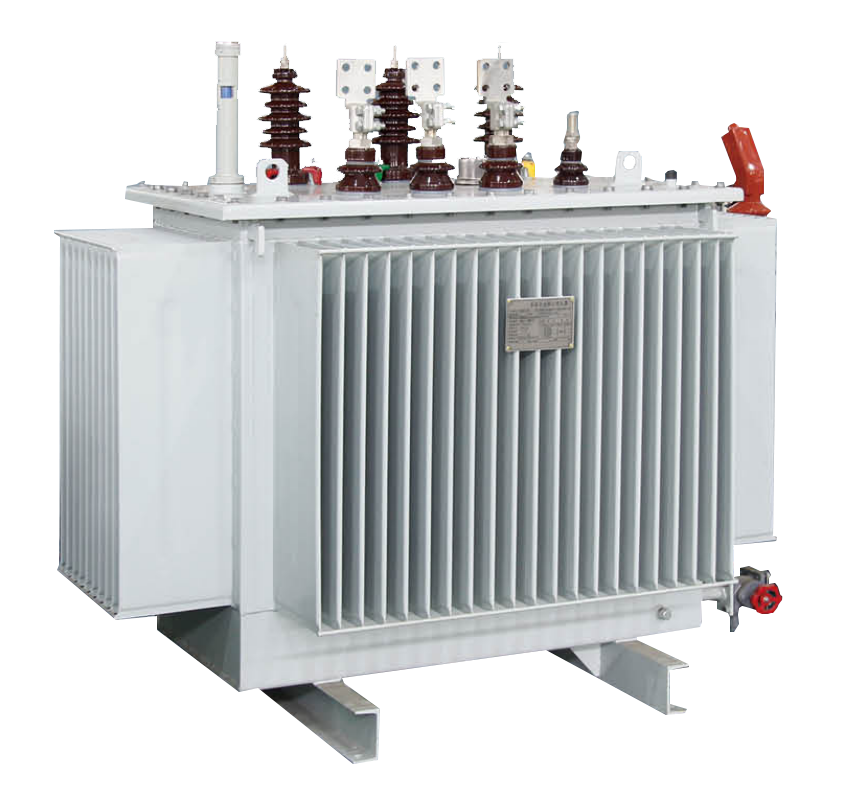
| Oil-immersed (ONAN/ONAF) | Oil natural / forced | 50 kVA – 100 MVA | Suez industrial zone, power plants | Requires oil maintenance; fire risk indoors |
| Dry-type (cast resin) | Air natural | 50 kVA – 25 MVA | Indoor factories, hospitals, data centres | Higher unit cost; derates faster in dust |
| Autotransformer (three phase autotransformer) | Oil or air | Up to several hundred MVA | Grid interconnection (≤ 2:1 ratio) | No galvanic isolation; ratio ≤ 2:1 |
| Renewable-energy specialist | Oil or dry | 630 kVA – 10 MVA | Solar/wind farms, Sinai projects | Higher initial cost; needs harmonic spec |
How the turns ratio drives the voltage step-up
Think of the turns ratio like a gear system in a car: changing the gear ratio changes the speed without altering the engine's mechanical output power. Similarly, winding more turns on the secondary side of a high voltage power transformer raises the output voltage while current decreases proportionally — keeping apparent power (kVA) constant, minus losses. For example, a 480V to 4160V transformer has a turns ratio of approximately 1:8.67, meaning every turn on the primary corresponds to 8.67 turns on the secondary.
Egypt grid standards and EEA compliance requirements
Egypt operates a 50 Hz alternating-current grid. The Egyptian Electricity Authority (EEA) mandates specific nominal voltage levels for equipment connected to the national network: 380V (low voltage), 11 kV and 33 kV (medium voltage), and 66/220/500 kV (high voltage transmission). Any 3 phase step up transformer destined for Egyptian projects must be specified and type-tested against these levels — not North American 60 Hz standards.
In practice, this means the most common step-up configurations in Egypt are:
- 380V → 11 kV: factory-level generation or large UPS integration stepping up to the medium-voltage distribution network
- 690V → 33 kV: standard solar inverter output to grid injection in Benban and Sinai solar clusters
- 11 kV → 33 kV: sub-transmission upgrades in expanding industrial areas
EEA technical approval and type-testing obligations
The EEA requires all medium-voltage power distribution transformers to carry type-test certificates aligned with IEC 60076 (power transformers) and, where applicable, IEC 62271 for associated switchgear. Imported units must also clear Egyptian customs with HS code documentation and may be subject to a conformity inspection by the Egyptian Organization for Standardization (EOS). According to recent procurement data, import duties on power transformers entering Egypt range from 5% to 15% depending on capacity and origin country — a cost that procurement managers must factor into total landed cost comparisons.
Delta-Wye winding and neutral grounding in the Egyptian four-wire system
Egypt's low-voltage distribution network uses a three-phase four-wire system (380V line-to-line / 220V line-to-neutral). The delta wye transformer configuration — specifically the Dyn11 vector group — is overwhelmingly the EEA-preferred arrangement for step-up applications connecting to this network. Why? The delta primary suppresses third-harmonic currents and prevents them from propagating into the HV side, while the star (wye) secondary with solidly grounded neutral provides the 220V single-phase outlets required by Egyptian load profiles.
The Dyn11 designation also produces a 30° phase shift between primary and secondary. For parallel transformer operation — common in large Egyptian industrial parks — all units must share the same vector group. Mismatching vector groups causes large circulating currents that can destroy windings within minutes. This is a compliance issue, not merely a design preference.

How to select the right capacity and winding configuration
Capacity sizing is where most specification errors occur. The correct approach is not to match transformer kVA to connected load kW — it is to account for power factor, starting current peaks, and planned load growth simultaneously.
Step-by-step capacity sizing method
- Calculate total connected load (kW): sum all motor, lighting, HVAC, and process loads at their nameplate ratings.
- Apply a demand factor: in Egyptian heavy-industry facilities, a demand factor of 0.75–0.85 is typical based on real operational data from Suez zone audits.
- Convert to kVA using power factor: divide kW by the site power factor (commonly 0.85 in Egyptian industrial sites). A 500 kW load at 0.85 pf = 588 kVA.
- Add a motor starting surge margin: the largest motor's locked-rotor current (typically 6–7× full-load current) must not cause the transformer secondary voltage to dip below 85% of nominal. Add 20–30% capacity buffer for sites with direct-on-line motor starters.
- Apply climate derating: for Egyptian desert sites where ambient temperature exceeds 40°C, apply IEC 60076-2 derating — typically 1% per °C above 40°C. At 45°C, a 1,000 kVA unit effectively delivers ~950 kVA continuously.
- Select the next standard rating: IEC standard ratings are 50, 100, 160, 200, 250, 315, 400, 500, 630, 800, 1000, 1250, 1600 kVA. Always round up, not down.
"Correct transformer sizing is the single most impactful decision in a substation project. An undersized unit will fail within 3–5 years from thermal aging; an oversized one wastes capital and increases no-load losses for its entire 25-year life." — IEC Technical Committee 14, guidance note on power transformer application, referenced in the distribution transformer guide.
Choosing between oil-immersed and dry-type for Egyptian conditions
Actual testing in Egyptian field conditions reveals a consistent pattern: oil-immersed units handle sustained 45°C+ ambient temperatures more reliably than dry-type units of equivalent rating, because the oil bath provides a much larger thermal mass. Dry-type cast-resin transformers are preferred only when the installation is indoors, fire risk is a regulatory concern (e.g., petrochemical control buildings), or the site is near the Nile Delta where humidity could damage oil seals. For open-air desert substations in the Western Desert or Sinai, oil-immersed ONAN with conservator tanks remains the dominant and most cost-effective choice.
Key application scenarios in Egypt
Egypt's industrial and energy landscape in 2026 creates three distinct demand clusters for the industrial step up transformer market. Each has unique technical requirements that a generic datasheet will not address.
Suez industrial zone: heavy manufacturing loads
The Suez Canal Economic Zone (SCZone) hosts steel rolling mills, cement plants, and chemical facilities drawing loads from 2 MVA to over 50 MVA. These sites typically receive 11 kV medium-voltage supply from the EEA grid and use step up power transformer units to feed internal 33 kV ring networks for large motor drives. The critical specification here is short-circuit withstand current — IEC 60076-5 requires the transformer to survive a 2-second fault without mechanical or thermal damage. For 11 kV class units, this typically means a short-circuit impedance (Zk%) of 6%–8%.
Sinai and upper Egypt: solar and wind grid injection
Egypt's renewable energy programme — targeting 42% renewable electricity by 2030 — has made the electrical step up transformer a high-demand product. Wind turbines in Zafarana and Gulf of Suez generate at 0.69 kV; photovoltaic inverters in Benban output at 0.4–1.5 kV. Both must be stepped up to 33 kV for injection into the national grid. The renewable-energy specialist transformer differs from a standard unit in three ways: it tolerates higher harmonic content (typically up to THD 15%), uses a low-loss amorphous-core or grain-oriented silicon steel to minimise no-load losses during overnight low-generation periods, and incorporates tap-changer positions to accommodate the wide voltage variation of inverter outputs.
Oil and gas sector: pump station and upstream applications
The Western Desert oil fields and Suez Gulf offshore platforms use HV step up transformers to power high-voltage motor-driven submersible pumps and compressors. A typical ESP (electrical submersible pump) installation steps 380V up to 3–5 kV across the downhole cable. These applications demand high dielectric strength insulation, Class F or H winding temperature ratings, and ATEX/IECEx zone-2 compliance for explosive atmosphere exposure. Procurement managers in this sector should insist on factory acceptance tests (FAT) with full impulse voltage testing before shipment.
Brand and price comparison for the Egyptian market
Why do so many buyers overpay for step up transformer price in Egypt? Mainly because they compare nameplate kVA ratings without accounting for total cost of ownership (TCO) over a 25-year lifespan. The table below provides a realistic 2026 market comparison based on recent procurement inquiries in the Egyptian market.
| Brand | Origin | Approx. price (EGP), 1000 kVA, 380V/11kV, Dyn11 | IEC 60076 certified | Local after-sales support | Lead time (weeks) |
|---|---|---|---|---|---|
| ABB (Hitachi Energy) | Europe / local assembly | EGP 1,800,000–2,400,000 | ✓ Full type test | Cairo service centre | 12–20 |
| Siemens Energy | Germany / regional | EGP 1,700,000–2,200,000 | ✓ Full type test | Cairo + Alexandria | 14–22 |
| Voltamp (Egypt) | Egypt (domestic) | EGP 950,000–1,300,000 | ✓ EOS + IEC aligned | Nationwide | 4–8 |
| TBEA (China) | China | EGP 800,000–1,100,000 | ✓ IEC type test | Limited (agent-based) | 16–28 |
Note: Prices are indicative estimates based on recent 2026 market inquiries and exclude VAT, customs duties (5–15%), and installation. Exchange rate fluctuations significantly affect imported equipment costs. Always request a formal quotation.
TCO analysis: why the cheapest unit rarely wins
A 1,000 kVA transformer running at 70% load for 8,000 hours per year will consume roughly 5,600–8,000 kWh annually in no-load and load losses alone. At Egypt's current commercial tariff of approximately EGP 1.25/kWh (Tier 3), that translates to EGP 7,000–10,000 per year in loss-related energy costs. Over 25 years, a unit with 30% higher losses costs an additional EGP 52,000–75,000 — often exceeding the initial price difference between a premium and budget unit. Amorphous-core technology, where available, reduces no-load losses by up to 70% versus standard silicon-steel cores, offering payback periods of 4–6 years in high-utilisation Egyptian industrial applications.
Import duties and procurement logistics in Egypt
Imported step up transformer manufacturer products entering Egypt are subject to customs duties, value-added tax (14%), and potentially anti-dumping provisions. EOS conformity certificates are mandatory for border clearance. Shipping large oil-immersed units (which can weigh 4–15 tonnes at 1–5 MVA) from Europe or China to Alexandria or Ain Sokhna port typically adds 8–12 weeks to project schedules. Domestic sourcing from Voltamp or similar Egyptian manufacturers eliminates these delays and currency risks — a significant operational advantage for projects with tight commissioning deadlines.
Installation, maintenance, and desert-climate considerations
Installation quality directly determines transformer lifespan. A correctly sized unit installed poorly in Egypt's desert environment will fail prematurely. Conversely, a well-maintained oil-immersed transformer can reliably deliver its rated capacity for 30+ years. Here is what field experience in Egyptian industrial sites consistently shows.
Desert-climate derating and thermal management
IEC 60076-2 establishes a reference ambient temperature of 40°C. Egypt's desert regions regularly see summer peaks of 45–50°C. At these temperatures, transformer winding insulation ages approximately twice as fast as at 40°C (per the Montsinger rule: each 8°C rise doubles the aging rate). Practical mitigation strategies used in Egyptian oil and gas and solar projects include:
- Specifying ONAF cooling (oil natural, air forced) with automatic fan switching above 80% rated load
- Installing transformer enclosures with ventilated sunshades, reducing radiant heat gain by 15–20°C on the tank surface
- Applying a derating factor of 1% per °C above 40°C — at 48°C, limit continuous loading to 92% of nameplate kVA
- Scheduling preventive maintenance (oil sampling, dissolved gas analysis) twice yearly rather than the IEC-recommended annual cycle
Dust, sand ingress, and IP rating requirements
Sandstorms in Upper Egypt and the Sinai Peninsula deposit fine silica particles in cooling fins and on bushing surfaces. For outdoor oil-immersed units, this is less critical — the sealed tank protects internals. But for dry-type units or outdoor terminal boxes, specifying at minimum IP55 enclosures is non-negotiable in these regions. Bushing creepage distances should also be increased to the "heavily polluted" IEC 60071 environment class (≥ 31 mm/kV) to prevent surface tracking in dusty conditions. Actual post-installation inspections from Sinai solar farms confirm that standard creepage distances resulted in flashover failures within 18 months — a costly lesson that informed subsequent procurement specifications.
Routine maintenance checklist for Egyptian operators
Based on a review of maintenance logs from Egyptian industrial facilities, the following schedule is recommended for oil-immersed three phase transformer winding systems operating in desert climates:
- Monthly: visual inspection of oil level, conservator, and Buchholz relay indicator; check for oil leaks at gaskets
- Quarterly: infrared thermography scan of bushings and HV terminals; check cooling fan operation
- Semi-annually: dissolved gas analysis (DGA) of oil sample — key indicator of internal arcing or overheating
- Annually: oil dielectric strength test (breakdown voltage ≥ 30 kV per IEC 60156); measure winding resistance and insulation resistance (IR > 1,000 MΩ at 5 kV DC)
- Every 5 years: full power factor (tan δ) test on bushings; consider oil filtration or replacement if DGA trends are adverse
Common mistakes and how to avoid them
Why do even experienced engineering teams make avoidable specification errors? Often because they rely on catalogues rather than application-specific analysis. Two industry misconceptions are particularly persistent in the Egyptian market.
Mistake 1: assuming a higher turns ratio is always better
A surprisingly common belief is that specifying a higher-voltage secondary provides extra margin. In reality, each voltage class demands a specific insulation level (BIL — basic impulse insulation level). A transformer rated 380V/33 kV must withstand a 170 kV lightning impulse, while a 380V/11 kV unit only requires 75 kV BIL. Specifying 33 kV when 11 kV suffices adds 20–35% to cost and physical size with no operational benefit. Match the secondary voltage strictly to the EEA connection point voltage — nothing higher.
Mistake 2: ignoring harmonic derating for variable-frequency drives
Modern Egyptian factories use VFDs extensively to control pump and fan motors for energy efficiency. VFDs generate harmonic currents (predominantly 5th and 7th order) that cause additional eddy-current losses in transformer windings — a phenomenon quantified by the K-factor rating system. A standard transformer has a K-factor of 1; a transformer feeding a VFD-heavy load may need K-4 or K-13 rating depending on the harmonic spectrum. Specifying a K-1 unit for VFD applications routinely leads to overheating and premature insulation failure, a fault pattern seen in multiple Egyptian textile and food-processing facilities. Of course, in applications with minimal harmonic content, a standard unit is perfectly adequate — context matters.
Mistake 3: skipping the factory acceptance test (FAT)
Is a FAT worth the cost and scheduling delay? The data says yes. IEC 60076-1 routine tests — ratio verification, winding resistance, no-load loss, load loss, short-circuit impedance — take one to two days at the manufacturer's facility but detect approximately 80% of manufacturing defects before the unit ships. Discovering a turns ratio error after installation in a remote Sinai location costs 10–20× more to rectify than catching it at the factory gate. For units above 1 MVA destined for critical Egyptian infrastructure, a witnessed FAT should be written into the purchase order as a contractual requirement.
Frequently asked questions
Q: What is the standard voltage configuration for a 3 phase step up transformer in Egypt?
A: The most common configurations are 380V/11 kV and 690V/33 kV, both at 50 Hz, aligned with EEA grid standards. The Dyn11 vector group is the default for industrial step-up applications feeding Egypt's three-phase four-wire distribution network. Always confirm the exact connection point voltage with the local EEA district office before finalising specifications.
Q: How much does a 3 phase step up transformer cost in Egypt in 2026?
A: For a 1,000 kVA, 380V/11 kV, Dyn11 oil-immersed unit, expect EGP 950,000–2,400,000 depending on brand, origin, and specification. Domestic Egyptian brands like Voltamp are significantly cheaper and offer faster delivery. European brands (ABB, Siemens) command a premium but provide full IEC type-test documentation preferred by international EPC contractors.
Q: How do I derate a transformer for Egypt's high ambient temperatures?
A: Apply IEC 60076-2 guidance: reduce continuous loading by 1% for each degree Celsius above 40°C. At 45°C ambient, limit the transformer to 95% of nameplate kVA; at 50°C, limit to 90%. For critical installations, also specify ONAF cooling and install ventilated sunshades to reduce radiant heat gain on the transformer tank.
Q: What is the difference between a Delta-Wye and a Wye-Wye transformer for step-up use?
A: Delta-Wye (Dyn11) is preferred for step-up because the delta primary blocks third-harmonic currents, prevents zero-sequence fault currents from propagating, and the wye secondary provides a grounded neutral for 220V single-phase loads. Wye-Wye (Yyn0) can be used but requires careful zero-sequence impedance management; without a delta tertiary winding, it is less stable under unbalanced load conditions common in Egyptian industrial environments.
Q: Can I use a three phase autotransformer instead of a two-winding step up transformer?
A: Yes, but only when the voltage ratio does not exceed 2:1 and galvanic isolation between primary and secondary is not required. Autotransformers are smaller and cheaper for modest step-up ratios (e.g., 11 kV to 33 kV grid interconnections). For large step-up ratios (e.g., 380V to 11 kV) or where isolation is mandated by EEA or site safety rules, a standard two-winding transformer is mandatory.
Selecting the right 3 phase step up transformer for Egyptian industrial and energy applications is a multi-variable engineering and commercial decision. Get the voltage class, vector group, capacity, and climate derating right — and then choose a supplier who can demonstrate EEA-compliant type testing and credible local service support. The framework in this guide gives electrical engineers and procurement managers a structured starting point for that evaluation, grounded in Egypt's actual grid standards, climate realities, and 2026 market conditions.
More news
We will send you real-time information regularly!

Optical storage charging solution supplier
Cangzhou Huarui Transformer Co., Ltd.
Address: Xinxing Town Industrial Zone, Qing County, Cangzhou, Hebei
All rights reserved©2024 Cangzhou Huarui Transformer Co., Ltd.
Powe : www.300.cn License city substation